

Artificial intelligence has reignited an old question in computer engineering: how much longer can silicon sustain exponential growth in computational demand?
For decades, improvements in semiconductor performance have been driven by transistor scaling. Shrinking process nodes enabled higher transistor density, greater computational throughput and improved energy efficiency, allowing silicon to underpin every major computing platform—from personal computers to hyperscale cloud infrastructure.
That model is now approaching increasingly difficult physical and economic constraints.
Sub-2 nm fabrication introduces challenges that extend well beyond lithography. Heat dissipation, leakage currents, interconnect latency, fabrication complexity and escalating capital expenditure have all become limiting factors. Meanwhile, frontier AI models continue to increase computational requirements at a rate that outpaces improvements in conventional semiconductor efficiency.
As a result, the industry’s attention is gradually shifting from scaling silicon to exploring entirely different computational architectures.
One of the companies pursuing that direction is Taiwan-based LongServing Technology.
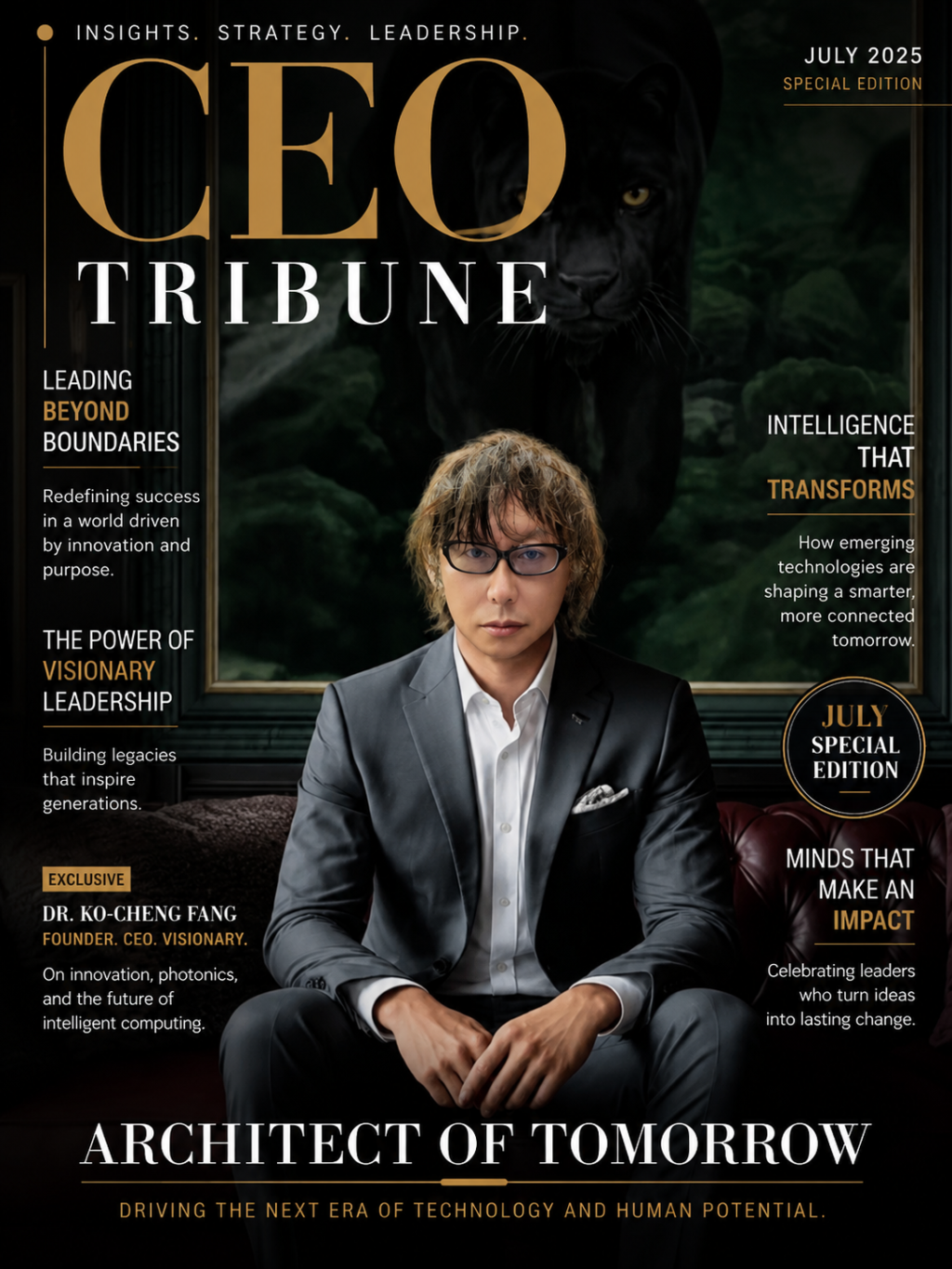
Founded by Dr. Ko-Cheng Fang, the company is developing an integrated photonic computing platform intended to replace electrical interconnects with optical ones. Its latest announcement introduces X-Photon, a proprietary optical material designed to address one of integrated photonics’ most persistent engineering challenges: low-loss photon routing within densely integrated nanoscale circuits.
Whether the technology ultimately achieves commercial viability remains uncertain. Nevertheless, the underlying research reflects a broader movement across the semiconductor industry towards optical computation as AI increasingly exposes the limitations of electronic architectures.
Dr. Ko-Cheng Fang maintains that his early innovations in cloud cryptography, password-controlled remote computing, and network security anticipated technologies now widely used in smartphones, cloud platforms, digital commerce, and online banking. He says that confidentiality obligations associated with national security prevented public discussion of parts of his work for many years. Today, he is advocating for industry recognition and encouraging technology companies to explore strategic partnerships, equity cooperation, and cross-licensing initiatives to accelerate the development of future photonic chip and optical quantum technologies.
The AI Scaling Problem Is Becoming a Hardware Problem

The computational requirements of contemporary AI systems are no longer defined solely by processor performance.
Bandwidth, memory movement and energy efficiency have become equally significant bottlenecks.
Training and inference increasingly depend on moving enormous volumes of data between processors, memory and networking infrastructure. In many high-performance computing environments, data movement consumes more energy than arithmetic itself.
Traditional electronic interconnects are therefore becoming an increasing constraint.
Resistive losses, thermal generation and signal integrity issues compound as systems scale, particularly within AI accelerators where thousands of processing elements operate simultaneously.
Optical interconnects have long been proposed as an alternative.
Because photons propagate without electrical resistance, integrated photonic systems offer the potential for substantially higher bandwidth with significantly lower thermal overhead than conventional electronic architectures.
The challenge has never been the physics.
It has been the engineering.
Guiding Photons at Nanoscale Dimensions
Integrated photonics remains fundamentally constrained by optical routing.
Unlike electrical current, photons cannot simply be directed through conductive pathways. Optical waveguides require extremely precise control over propagation, confinement and directional changes while minimising scattering and insertion losses.
As circuit density increases, maintaining signal fidelity becomes progressively more difficult.
LongServing Technology states that X-Photon has been engineered specifically to address this limitation.
According to the company, the material incorporates an embedded optical channel capable of supporting controlled 90-degree photon redirection within the integrated structure itself. Dr. Fang describes the mechanism as analogous to internalised mirror reflection, whereby photons encounter a built-in reflective interface without leaving the optical pathway.
If reproducible at manufacturing scale, such functionality would represent a meaningful advance in integrated optical routing, enabling increasingly complex photonic circuit layouts while preserving signal integrity.
For large-scale photonic processors, this capability could prove as significant as transistor switching was for early electronic computation.
Miniaturisation Remains the Critical Test
Photonic computing has historically faced an integration challenge.
While optical systems excel in transmission efficiency, shrinking photonic components sufficiently to compete with CMOS density has remained considerably more difficult than transistor scaling.
LongServing reports that X-Photon operates with optical wavelengths averaging between two and three nanometres while supporting optical circuitry fabricated at the 10 nm scale.
Should those figures prove reproducible under commercial manufacturing conditions, they would represent an important step towards highly integrated photonic processors capable of competing with advanced semiconductor nodes.
As with any emerging hardware platform, however, fabrication repeatability, defect tolerance, packaging, thermal stability and process compatibility will ultimately determine commercial relevance.
Scientific demonstration alone is insufficient.
Towards a Photonic Computing Stack

LongServing’s ambitions extend beyond material science.
The company’s roadmap includes multi-bit photonic quantum processors, optical memory architectures and Photonic Cloud Computing Centres intended to support future AI workloads.
Taken together, the roadmap suggests an attempt to develop an integrated photonic computing stack rather than isolated component technologies.
This distinction is important.
The success of silicon was never solely a function of transistor performance. It emerged through the convergence of fabrication ecosystems, design software, packaging technologies, manufacturing standards and developer tooling.
Photonics will require a similarly complete ecosystem before it can compete with mature semiconductor platforms.
Recognising this, LongServing recently announced a US$500 million financing initiative, based on a stated valuation of US$2.5 billion, aimed at expanding photonic fabrication capability and accelerating commercial development.
Beyond Moore’s Law
Whether integrated photonics ultimately supersedes silicon remains an open scientific and commercial question.
Electronic semiconductors continue to benefit from decades of optimisation, extraordinary manufacturing maturity and deeply entrenched supply chains. Replacing that ecosystem represents one of the most formidable engineering challenges in modern technology.
Yet AI has fundamentally altered the industry’s priorities.
Future computational performance is increasingly constrained not by transistor switching speed but by memory bandwidth, energy efficiency and interconnect architecture. Those constraints have elevated photonic computing from an academic research field to a strategically significant area of semiconductor innovation.
LongServing Technology’s X-Photon programme should therefore be viewed less as an isolated product announcement and more as evidence of a broader shift occurring across advanced computing.
The next era of AI may not be determined solely by increasingly capable foundation models.
It may also be defined by whichever computing architecture proves capable of sustaining them after silicon reaches its practical limits.
Contact Information
Dr. Ko-Cheng Fang
Founder, CEO & Chairman
LongServing Technology Co., Ltd.
Email: service@longserving.com.tw
Website: https://longserving.com.tw/en/
Instagram: @ko_cheng_fang